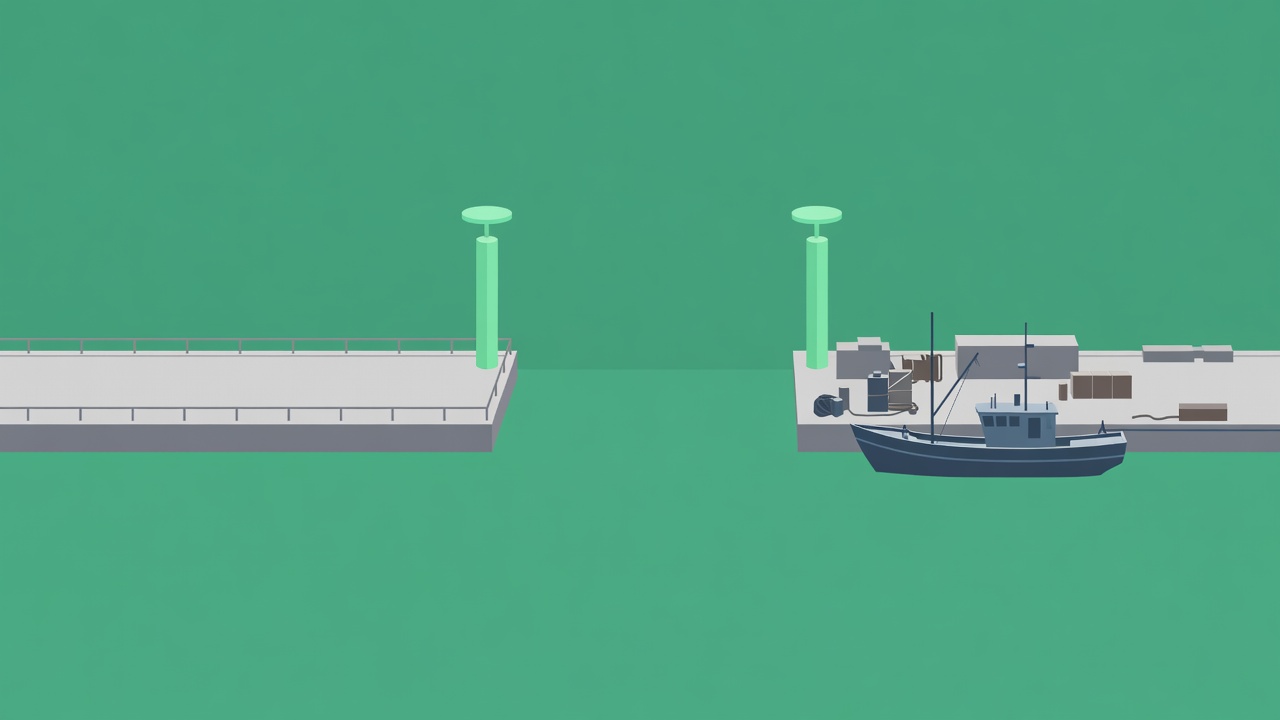
Harbours can look reassuringly manageable after a cliff walk. There are buildings, paved surfaces and somewhere to sit. Yet the hazards are often concentrated rather than absent: an unguarded quay edge, a moving vehicle, a wet ladder or a wave crossing a pier. The right approach is curious but unhurried, with a clear distinction between a public promenade and a working space.
Entrance lights are particularly useful subjects for a walk because they explain how the harbour meets the wider coast. Rather than aiming immediately for the outermost point, begin inland and observe how the waterway, buildings and breakwaters guide your attention towards the sea.
Whitby: begin with the river
At Whitby, the River Esk gives the harbour its organising line. Following the public waterfront can reveal changes in scale: sheltered river activity, busier quays and the more exposed entrance beyond. The pier lights are not isolated monuments. They form part of the harbour's working arrangement and are best understood in that setting.
Do not assume that both sides of an entrance can be joined in a neat circuit, or that a route shown in a photograph remains open. Bridges, access restrictions and works can change the practical shape of a walk. Confirm the available crossings and allow time to return without rushing towards an uncertain connection.
The outer structures may be appealing in photographs, especially when waves rise behind them. That is not an invitation to approach. Respect gates and closures, and do not treat other people standing on a pier as evidence that it is safe. Observe from a sheltered public position if spray or overtopping is present.
Read the signals without using them as directions
A lighthouse, a small pier light and a pair of harbour entrance marks do not necessarily serve the same purpose. Their positions and characteristics are chosen for mariners, and local arrangements vary. A shore-based visitor can appreciate the engineering without trying to interpret an entrance as though they were navigating a vessel.
Look for an official interpretation panel or local museum explanation. Ask what the structure was intended to make visible, whether earlier versions existed, and how the harbour changed around it. The most rewarding detail may be a repair seam, a change in masonry, or the relationship between the entrance and an older waterfront.
The quieter route behind the quay can tell as much as the walk to the pier end.
Keep a working distance
A fishing harbour is not arranged primarily for spectators. Ropes may tighten unexpectedly, vehicles may reverse, and equipment may occupy areas that resemble public space. Keep clear of lifting operations and never step over a line to improve your view. If access is unclear, stop and ask from a safe position rather than walking into the activity.
Photographs also deserve thought. A broad view of a harbour is different from a close photograph of someone working. Give people space, ask when appropriate and do not block a route while composing a picture. Keep dogs close and children away from quay edges even where the surrounding streets feel familiar.
Wear footwear suited to wet stone, algae and uneven surfaces. A flat route may still be unsuitable for someone who needs consistent grip or a protective edge. If step-free access is important, ask about the whole journey: surface, gradients, crossings, gates, seating and toilets, not just the first section of promenade.
Build a walk that has an easy ending
- Start landward. Identify a public route and a sheltered point from which the harbour entrance can be understood without reaching it.
- Check the working day. Look for harbour notices, temporary barriers and signed pedestrian diversions. Work activity can change what is available.
- Keep the return simple. Prefer a known public route over an improvised shortcut across a yard, slipway or beach.
| Place or feature | What to confirm |
|---|---|
| Public quay | Pedestrian access, vehicle movements and edge protection |
| Pier or breakwater | Current closures, wave exposure and the permitted walking area |
| River crossing | Open route, operating arrangements and a reliable return option |
Let the harbour remain itself
Not every walk needs an uninterrupted sea view. A back street, interpretation board or small maritime collection can add context while avoiding the most exposed part of the shore. Plan a visit around attention rather than completion, and accept that a closed pier may still leave a full and interesting afternoon.
The RNLI's safety information is a useful general reference, but local harbour notices and current conditions remain essential. Roverbravil does not verify pier access or provide live harbour information. For a different kind of boundary between land and water, turn to island lights and their approaches.